Themes and history tie-ins for discussion:
perseverance
mother-daughter relationship
life choices and consequences
self-image
independence
journeys
role-conflict
family history
women's suffrage
Panic of 1893
presidential campaigns
economic depression
women's clothing
bicycle costume
bicycle craze
yellow journalism
William McKinley
William Jennings Bryan
Joseph Pulitzer
Nellie Bly
The Panic of 1893 was the worst economic catastrophe the nation had ever endured up to that time. For example, by 1896 when Clara and her mother walked across the country, seven out of ten banks in nearby Spokane, Washington, had failed and thousands of families in Spokane County had lost their life savings.
By some estimates nearly one out of five people was out of work. Drought had spoiled year after year of crops; many families across the country were losing their farms. Hoboes rode the rails, looking for odd jobs and handouts. General Coxey led a march of the unemployed from Ohio to Washington, D.C.
The year of Clara and Helga's walk, William McKinley and William Jennings Bryan were running for President with different plans to pull the country out of economic depression. Clara Estby would have voted for McKinley and her mother would have voted for Bryan, but women couldn't vote yet, so their opinions didn't count.
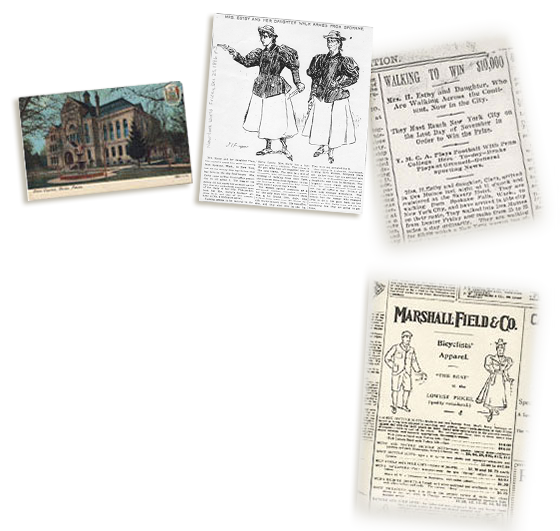
Desperate times required desperate measures, but Clara and Helga's plan to save their farm and prove women deserved the vote was more desperate than most: They planned to walk four thousand miles from their farm in Mica Creek, Washington to New York City by a deadline what would win them $10,000. Their walk would also prove that women deserved the vote, because they would demonstrate that women were more resourceful, intelligent, and persevering than men gave them credit for.
They set out without a change of clothes and only five dollars apiece, wearing corsets and mud-dragging skirts. They had no high-performance hiking shoes, backpacks, instant food, Gore-tex; no GPS and no cell phone emergency contact with the rest of the world.
They walked 232 days with only a seven-pound satchel each, with first aid supplies, maps, a pistol, pepper spray, canteens, and curling iron. Their survival is a tribute not only to their bold spirits, but to the hundreds of people who took them in for the night, fed them, gave them work to earn money for the next pair of shoes. Along the way, they met a wide range of people outside their little enclave of Norwegian immigrants back in Mica Creek, from hoboes to president-elect, McKinley.
Here are other books you might like if you liked The
Year We Were Famous:
The Ballad of Lucy Whipple, by Karen Cushman
Boston Jane, by Jennifer Holm
Hattie Big Sky, by Kirby Larson
Lyddie, by Katherine Paterson
Northern Light, by Jennifer Donnelly
Sara Plain and Tall, by Patricia MacLachlan
Bold Spirit, by Linda Lawrence Hunt (adult non-fiction about Helga Estby)
The Daughter's Walk, by Jane Kirkpatrick (adult fiction about Clara Estby)